Royal Canadian Legion # 138 Minnedosa, MB
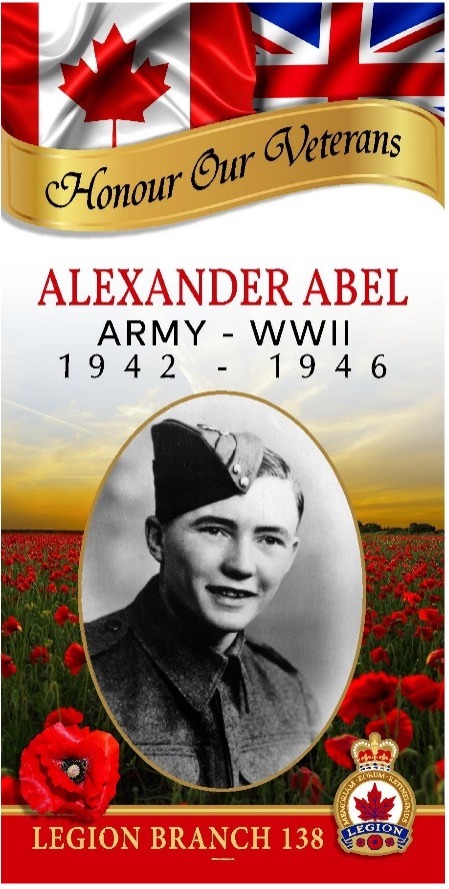
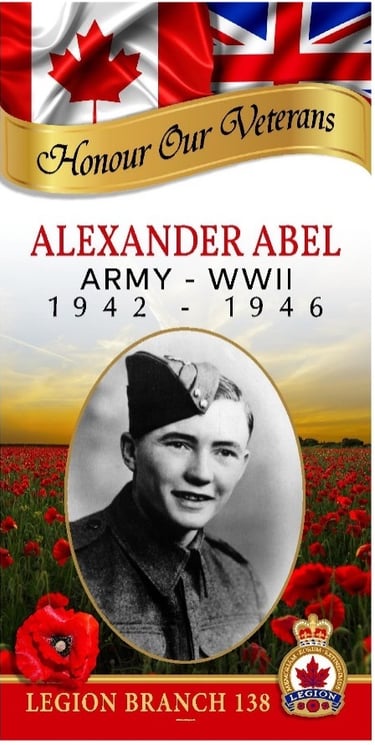
Alexander Brigham Abel
Gunner, Royal Canadian Artillery
Service Summary
Alexander Brigham Abel enlisted with the Royal Canadian Artillery on January 16, 1942, and completed his basic and advanced training in Brandon, Manitoba. Due to his age, he initially remained in Canada while others were sent overseas, serving in a heavy anti-aircraft battery in Sault Ste. Marie, Ontario, helping defend critical infrastructure.
In September 1943, he deployed overseas, travelling aboard the Queen Mary to Scotland before continuing to Aldershot, England, where he completed further training, including driver training.
Wartime Experience
In January 1944, Alexander was posted to the 18th Battery, 2nd Canadian Anti-Tank Regiment, 2nd Division. He later became part of the 7th Brigade, 3rd Canadian Division in preparation for the Normandy invasion.
On June 6, 1944—D-Day—he landed in Normandy as part of Operation Overlord. Within days of landing, he experienced heavy combat conditions, including German air attacks that caused significant casualties among Allied troops.
Throughout the campaign, Alexander carried out dangerous and demanding duties, including guarding large numbers of German prisoners under exposed conditions and undertaking high-risk movements under sniper fire.
In August 1944, after suffering a severe infection caused by shrapnel, he was evacuated by hospital ship. During the voyage, the ship was torpedoed and sank within minutes. Displaying remarkable presence of mind and selflessness, Alexander assisted a severely injured fellow soldier before escaping into the water, where he was later rescued by an American vessel.
After recovering in England, he returned to active service in Europe, participating in operations in France, Belgium, and the Netherlands. His unit played a key role in clearing enemy positions, including actions supporting the advance into Antwerp.
He later served along the Holland-Germany border and took part in the Allied advance into Germany in 1945, contributing to the eventual liberation of occupied territories.
Post-Service Life
Following the end of the war, Alexander returned to Canada in November 1945 and was discharged on January 10, 1946.
He returned to farming, eventually purchasing the family farm. On December 30, 1950, he married Verna Gibson, and together they raised a family of four children.
In 1989, Alexander and Verna retired to Minnedosa, where he became a Life Member of Royal Canadian Legion Branch #138. He remained an active and respected member of the Legion community until his passing in 2018.
Medals & Honours
Canadian Volunteer Service Medal and Clasp
Defence Medal
France and Germany Star
1939–45 Star
War Medal 1939–45
French Legion of Honour (awarded in 2017)